
“People don’t leave bad jobs. They leave bad managers.” It is one of the most repeated phrases in leadership. Like most clichés, it contains an important truth—but it is also incomplete.
Employees leave when the environment created by their manager consistently threatens what they value most at work.
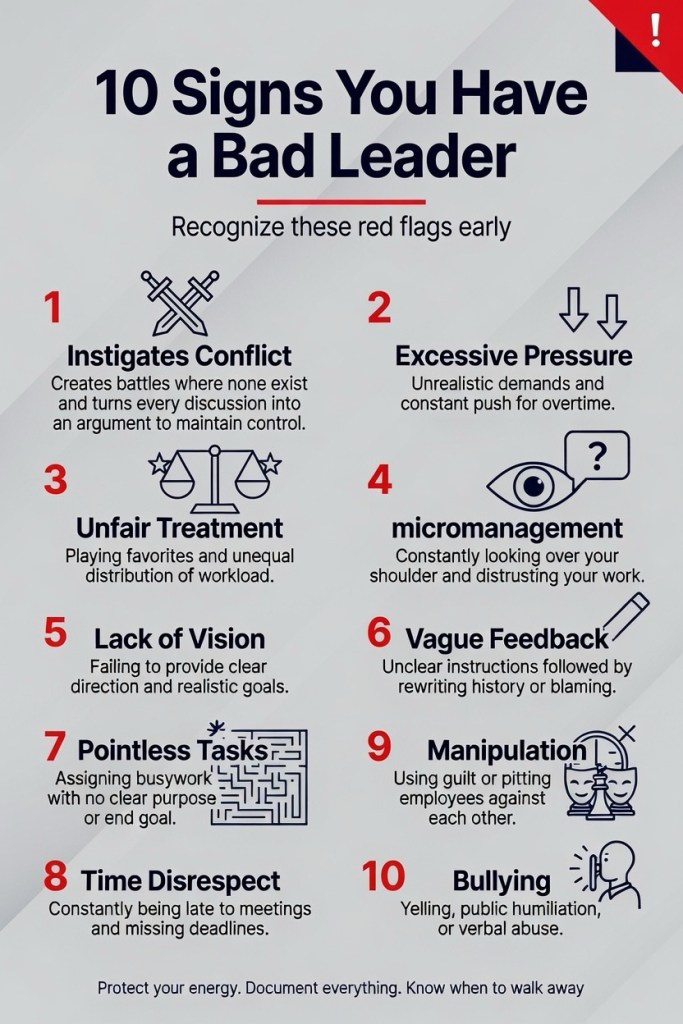
The image above lists ten warning signs of poor leadership:
- Instigates conflict
- Excessive pressure
- Unfair treatment
- Micromanagement
- Lack of vision
- Vague feedback
- Pointless tasks
- Time disrespect
- Manipulation
- Bullying
These behaviours are damaging on their own. However, neuroscience helps explain why they are so destructive.
The SCARF Model
David Rock’s SCARF Model suggests that people are motivated by five social needs that the brain experiences almost as strongly as physical rewards or threats.
SCARF stands for:
- Status – feeling respected and valued.
- Certainty – knowing what to expect.
- Autonomy – having control over how work is done.
- Relatedness – feeling connected and trusted.
- Fairness – believing people are treated equitably.
When leaders threaten one or more of these needs repeatedly, employees don’t simply become dissatisfied—they begin looking for an exit.
Status: “Do I Matter Here?”
For employees who place a high value on status, respect is everything.
Nothing destroys status faster than a leader who:
- Instigates unnecessary conflict.
- Belittles employees in front of others.
- Publicly humiliates people.
- Constantly arrives late, postpones or cancels meetings, signalling that other people’s time is unimportant.
- Gives vague criticism while withholding recognition.
These behaviours communicate one message:
“You don’t matter.”
People rarely remain in environments where they feel invisible or diminished.
Certainty: “Where Are We Going?”
Some employees are motivated by clarity and predictability.
They need to understand:
- the purpose,
- the priorities,
- the expectations,
- and how success will be measured.
Leaders undermine certainty through:
- lack of vision,
- repeatedly cancelling meetings,
- changing priorities without explanation,
- assigning pointless work,
- constantly moving the goalposts.
Eventually employees stop asking, “What’s next?”
Instead they begin asking, “Should I start looking elsewhere?”
Autonomy: “Can I Be Trusted?”
High performers typically value independence.
They want accountability—not constant supervision.
Leaders destroy autonomy through:
- micromanagement,
- manipulation,
- lack of strategic direction,
- assigning meaningless work,
- controlling every decision while refusing to delegate.
Ironically, the more capable the employee, the faster they become frustrated.
Talented people don’t leave because they’re asked to work hard.
They leave because they’re prevented from doing their best work.
Relatedness: “Do I Belong?”
Humans are social creatures.
We want to belong to teams where people support one another.
That sense of belonging quickly disappears when leaders:
- create conflict,
- encourage competition instead of collaboration,
- manipulate relationships,
- give vague feedback,
- micromanage every interaction,
- assign work that has no obvious contribution to the team’s purpose.
People may tolerate a difficult workload.
Few tolerate feeling isolated.
Fairness: “Is This Place Just?”
Of all the SCARF domains, fairness may be the easiest to destroy.
Playing favourites…
Unequal workloads…
Different rules for different people…
Political promotions…
Unequal access to opportunities…
These behaviours quickly erode trust.
Once employees conclude that decisions are based on favouritism rather than merit, engagement declines rapidly because effort no longer appears connected to reward.
Many people don’t resign from difficult work.
They resign from unfair systems.
Some Behaviours Threaten Everyone
While different employees place different weight on each SCARF dimension, certain leadership behaviours are universally destructive.
Few people enjoy working where:
- conflict is constantly manufactured,
- manipulation replaces honest conversations,
- excessive pressure becomes the default management style,
- bullying is normalised,
- fear is mistaken for accountability.
These environments activate multiple SCARF threats simultaneously.
Status is diminished.
Certainty disappears.
Autonomy is removed.
Relationships deteriorate.
Fairness is questioned.
The result is predictable:
Stress increases.
Innovation decreases.
Trust collapses.
Eventually the organisation loses precisely the people it can least afford to lose.
Why Do Some Leaders Behave This Way?
Not every difficult manager is malicious.
Some lack self-awareness.
Others repeat behaviours they experienced themselves.
However, there are also personalities that naturally gravitate towards dominance, manipulation, excessive control and conflict as leadership tools. Left unchecked, these behaviours can spread throughout an organisation as others learn that intimidation and political manoeuvring are rewarded.
This is why organisations cannot rely solely on leadership competency frameworks or annual employee engagement surveys.
Leaders must be equipped to recognise destructive behavioural patterns early, intervene decisively and hold managers accountable—not only for what they deliver, but how they deliver it.
Creating Places Where Talent Stays
Exit interviews often ask employees why they left.
Perhaps organisations should spend more time asking the people who stay why they continue to give their best.
The answers are unlikely to be surprising.
People stay where they feel respected.
They stay where leaders provide direction.
They stay where they are trusted.
They stay where they belong.
They stay where they are treated fairly.
In other words, they stay where their SCARF needs are consistently met.
As leaders, it is not enough to know why talent leaves. We must be committed to creating environments where talent thrives for the benefit of the organisation.
Because employees do not simply leave a team or an organisation.
More often than not, they leave the manager who made staying no longer worth it.

