By Nomathemba Pearl Dzinotyiwei
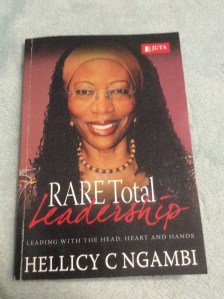
A RARE total leader is one who is responsible, accountable, relevant and ethical. This model was proposed by Professor Hellicy Ngambi, former Dean of Economic and Management Sciences at UNISA in her book RARE Total Leadership (Juta. 2011). I believe that the pun was intentional because today such leadership is sorely lacking indeed. The number of stories of government corruption, waste and mismanagement as well as corporate scandals grows by the day. It speaks to a world that is crying out for leadership that serves the greater good in society, and not the narrow selfish interests of a few in power with access to resources. So what is RARE Total leadership and what does it entail?
Responsibility means having a duty to deal with something or of having control over someone. (www.dictionary.com). A responsible leader is visionary, inspiring and gets things done. According to Winston Randolph Churchill, former British Prime Minister : “The price of greatness is responsibility.”
Accountability means being required or expected to justify actions or decisions. An accountable leader communicates with stakeholders and takes ownership of decisions and does not play the blame game, scapegoat others or make excuses for toxic behavior (Ngambi. 2011).
Relevance is being closely connected or appropriate to what is being done or considered. A leader who is relevant understands the current situation and future trends of the organization he or she is working in, the situation in the country and the world at large and uses that knowledge to inform his or her decisions.
Ethics considers what is morally right in a given situation. An ethical leader is one whose behavior advocates honesty, integrity, openness and trust (Ngambi. 2011).
In addition to explaining these, she also reviews existing theories on leadership, and extensively discusses the role of cognitive and emotional intelligence. Prof. Ngambi introduces two new elements to the leadership discussion: spiritual intelligence, which is an awareness of the unseen and taps into intuition to inform decisions in the absence of facts and physical evidence; and African intelligence, which emphasises, shared values, community and connection through ritual and recreation. These two elements are key to unlocking the often touted African solutions for problems facing teams and organizations on Africa. This leads to the concept of total leadership.
THE 3 Hs of TOTAL LEADERSHIP: HEAD, HEART & HANDS
Prof. Ngambi advocates for a threefold model of leadership styles: leading with the head, heart and hands. All three need to work together for effective leadership. She explains the advantages and disadvantages of each leadership style. The ones leading with their heads only not, hearts and hands, focus on facts and data exclusively to make decisions. She outlines how the brainy plummet saying the downfall of these leaders is due to the following: their inability to listen; being self-centered; greedy; proud; arrogant; yet at the same time they are ignorant, insecure and blame others for their mistakes. They have an inability to learn because they think they are perfect and do not plan for succession. This is a profile of a typical toxic leader, who leads through fear and intimidation. Such leaders leave before the organisation falls apart and they blame their successors yet they created the mess.
Heart-centered leaders, prioritise the feel-good factor, considering the impact on people when making decisions. On the downside, they fear losing people’s approval and are unable to balance the interests of the people with those of the organisation. Their fear of criticism means they are unable to make difficult decisions which can lead to the eventual downfall of the organisation.
A hands- on leader is hard-working, tireless in getting things done and is successful as an individual. However in their absence, things fall apart because they don’t often document anything, nor do they train or prepare others to fulfill their role when they are no longer there, for whatever reason. Their legacy either dies with them or disappears completely when they leave.
An effective leader is one who: inspires others; sets goals; creates structure and clarity for goals to be achieved; gets involved in the work alongside the people and supports the development of other leaders. This requires certain habits that enable leaders to use their heads, hearts and hands – Total Leadership, while exercising the RARE principles to lead.
GOOD LEADERSHIP HABITS
A habit is an automatic pattern of reaction in reaction to particular circumstances. They may be inherited or attained through frequent repetition (Ngambi. 2011). Dr. Caroline Leaf In her videos on YouTube explains that it takes 21 days of daily repetitive activity or meditation for 5 minutes on an idea or concept to create a new habit, because the new thought pattern is established in your short-term memory. Another 21 days will establish it in your long-term memory and a further 21 days will establish it in your subconscious mind. Then after that, you do it on auto-pilot without consciously thinking about it (Ngambi. 2011).
Professor Ngambi identifies the seven following habits of RARE Total Leadership:
- Being stakeholder and people- focused. These leaders are visionary, committed to serving, empowering of their followers, trust-worthy, believe in team effort and are are driven by ethical values that aim for sustainability.
- Being knowledgeable, excellent and wise. They scan the environment, gather relevant knowledge and develop policy, systems and procedures that are efficient and effective. They are courageous, don’t rely on hearsay and are committed to acting according to principle-based values. They employ wisdom to solve problems.
- Being unique. Great leaders are not afraid to stand alone. They apply their cognitive abilities, wisdom, compassion and actions to package and present their value proposition. They take responsibility and accountability for decisions and the outcomes that follow.
- Communication. Great leaders communicate effectively. They listen, are accessible to all, not just a selected few favourites, they are excellent teachers and have the required intellect and empathy to spread their message to people at all levels and from different stakeholder groups. They are people of integrity and walk the talk so people trust their message and buy into vision whole-heartedly.
- Focused. Great leaders have clarity of mind. They understand the needs of all their stakeholders and a clear understanding of the capabilities of their organisation. They do not try to be all things to all people but focus on adding value where it is needed most. They are passionate about results, engage constantly and don’t give up. This gives those they lead the fuel to persevere.
- Growth. Great leaders have a growth mindset. If you’re not growing, you’re dying. They can spot opportunities for personal growth because they have a teachable spirit. They also exploit otherwise hidden opportunities – the native ability of thinking and emotionally intelligent leader.
- Connecting and building relationships. Great leaders form deep and meaningful connections with people they meet. They are exemplary in their thinking, feeling and behaviour, in the way they interact with others. They cultivate long-term relationships with stakeholders because they are connected, relevant and accountable. Such leaders create disciples not followers. The difference between the two is that a follower will be with that leader as long as their own needs are met. As soon as those needs are not met, they will find another leader. A disciple on the other hand is passionate about the vision and will endure personal hardship because of the personal connection with the leader and for the sake of fulfilling the vision.
Great leaders lead from the front and are constructive in the way they treat people. They demonstrate integrity and ethical behaviour and inspire employees’ commitment to quality and serving customers with pride. They have an unwavering commitment and a passion for people, values, quality service and excellent results. (Ngambi. 2011). Exercising these habits consistently will build one’s capacity for great leadership and inspire others to do the same.
HOW DOES ONE BECOME A RARE LEADER?
We know that RARE leadership is something that is desirable in an organization: to create psychological safety for employees; build loyalty; foster accountability and to provide innovative goods and services that will add value and do no harm to a society among other benefits. However, such leadership takes immense courage in an individualistic world driven by capitalist norms. The majority of leaders are driven by self-interest and have created super-structures with policy, procedures and norms to protect their positions and to benefit a privileged few who support the status quo. The majority of leaders who are dissatisfied with those conditions are too scared or lazy to challenge it. There are also benefits for those who do not rock the proverbial boat by challenging illegal, unfair and unjust practices in the organisation. How do we step up and become RARE leaders in an organizations, context that seems to demand the opposite, in order for one to succeed?
DARING GREATLY
This brings us to the work of Brene Brown, a social worker and researcher who studies shame, vulnerability and courage. Her TED talk from 2010 is one of the most-watched on YouTube. Here are a few quotes from her talk & the subsequent feature on Netflix.
On vulnerability she said: “Vulnerability is not winning or losing; it’s having the courage to show up and be seen when we have no control over the outcome.” According to her, there is no courage without vulnerability. Many of us as leaders are not willing to be daring enough, we lack the guts to risk emotional exposure and we fear failure. The reality is most organizations have zero to little tolerance for failure so we shy away from anything that presents that possibility. It could be speaking out against unjust practices that are harmful in the long-run. It could be hiring a potentially great employee on a hunch who doesn’t tick all the boxes in terms of the organizational norms. It could be advocating to stop a pet project sponsored by senior executives that is not delivering as promised. There are many scary situations in the workplace that require leaders to have the courage to speak up and persevere until the situations change.
She spends a lot of time speaking to C-Suite executives explaining how they can foster innovation and creativity by creating psychological safety through a tolerance for failure and creating learning opportunities. This sounds really great but is daunting in practice. She uses the example of her own experience after the TED talk when she was initially savaged by critics and spent the afternoon eating peanut butter sandwiches and watching Downton Abbey. She then read this quote by President Theodore Roosevelt which changed her perception:
“It is not the critic who counts; not the man who points out how the strong man stumbles, or where the doer of deeds could have done them better. The credit belongs to the man who is actually in the arena, whose face is marred by dust and sweat and blood; who strives valiantly; who errs, who comes short again and again, because there is no effort without error and shortcoming; but who does actually strive to do the deeds; who knows great enthusiasms, the great devotions; who spends himself in a worthy cause; who at the best knows in the end the triumph of high achievement, and who at the worst, if he fails, at least fails while daring greatly, so that his place shall never be with those cold and timid souls who neither know victory nor defeat.”
From that time on, she shook off the cloak of shame and changed her philosophy saying:
“A lot of cheap seats in the arena are filled with people who never venture onto the floor. They just hurl mean-spirited criticisms and put-downs from a safe distance. The problem is, when we stop caring what people think and stop feeling hurt by cruelty, we lose our ability to connect. But when we’re defined by what people think, we lose the courage to be vulnerable. Therefore, we need to be selective about the feedback we let into our lives. For me, if you’re not in the arena also getting your ass kicked, I’m not interested in your feedback”
FEEL THE FEAR BUT DO IT ANYWAY
For us to exercise RARE Total Leadership, we need to let go of perfectionism, of shame, of the fear that we are not good enough, of showing signs of weakness, and embrace our vulnerability, the real possibility that we may really get our asses kicked. However there is also the real possibility that we could succeed and we need to imagine how awesome that would be. We need to identify our values and principle and priorities and stick to these when we make decisions and act. If it fails, yes you’ll lose but you’ll learn. We need the capacity to take in constructive feedback and self-correct. Only then can we be the leaders that our teams, organizations, countries and the continent need us to be.
 The Corporate Humanitarian