By Nomathemba Pearl Dzinotyiwei
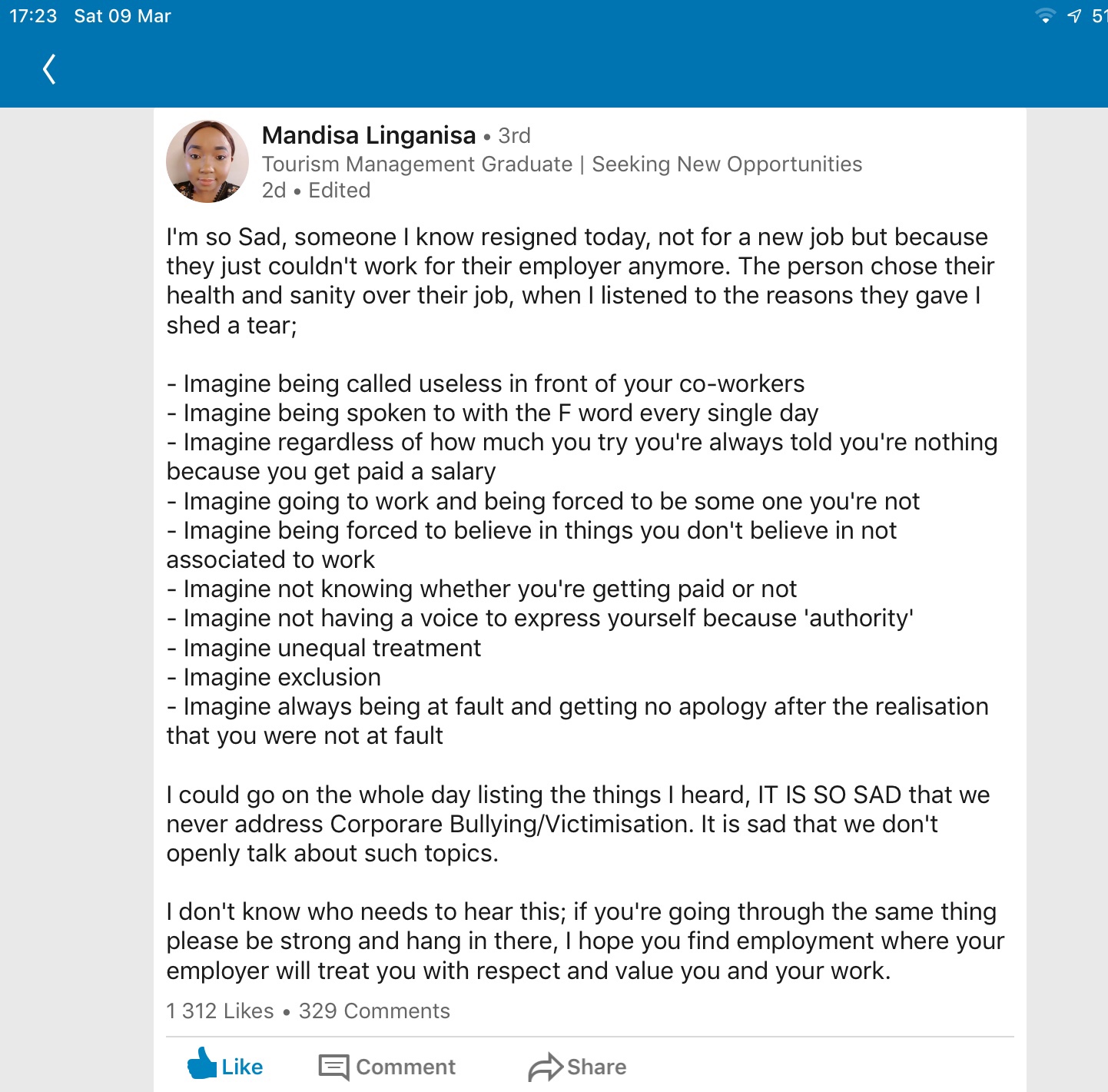
It breaks my heart to read stories like this one on LinkedIn. It brought back memories of the bullying that I’ve survived over the years. Employees are under siege. Times are tough for business, jobs are scarce and managers and executives take advantage of the situation to abuse employees and control them through fear. Employees endure the abuse because they need the income and there are few alternative options. Most workplaces are not equipped to deal with employees’ pain or deal effectively with abusive colleagues or managers.
Workplace Bullying: What It is and What it Isn’t
Bullying is not a series of random or isolated incidents of abuse. It is not a ‘personality clash’, a convenient explanation by HR practitioners and management seeking to sweep the problem under the carpet to avoid dealing with it. Bullying is a planned, systematic pattern of abuse and harassment where the bully seeks to destroy the victim’s the self-confidence in order to control him or her.
Effects of Workplace Bullying
Employees who are bullied are fearful, nervous, make more mistakes, take more sick leave and are prone to depression, chronic illness or in extreme cases suicide. Workplace bullying creates a toxic work environment and demoralizes other employees. A lot of energy is spent managing one’s own emotions and avoiding setting off the abuse and this damages a team’s effectiveness and the success of the company in the long run.
If Workplace Bullying So Damaging, Why Isn’t Anything Done About It?
Executives and senior management often look away because the bully is seen as being effective and brings results. Bullies are good at creating powerful alliances with peers, executives and board members. Bullies are very good at managing perceptions and often ‘kiss up and kick down’, meaning they are courteous and obsequious to their superiors yet rude and abusive to junior employees or colleagues they perceive to be less powerful.
Leadership and Culture: The Bully in the Corner Office
Some executives have bullying tendencies themselves and promote a culture of bullying to enable them to continue the toxic behaviour. They use an elaborate system to select, reward and promote favourite employees while denigrating and punishing the chosen victims and protecting the abusers in the company. They deliberately pit employees and teams against one another to prevent detection and this paralyzes any attempts by the organisation to deal with the problem. To better understand this dynamic, one needs to use a tool developed by Stephen Karpman called the Drama Triangle.
The Drama Triangle
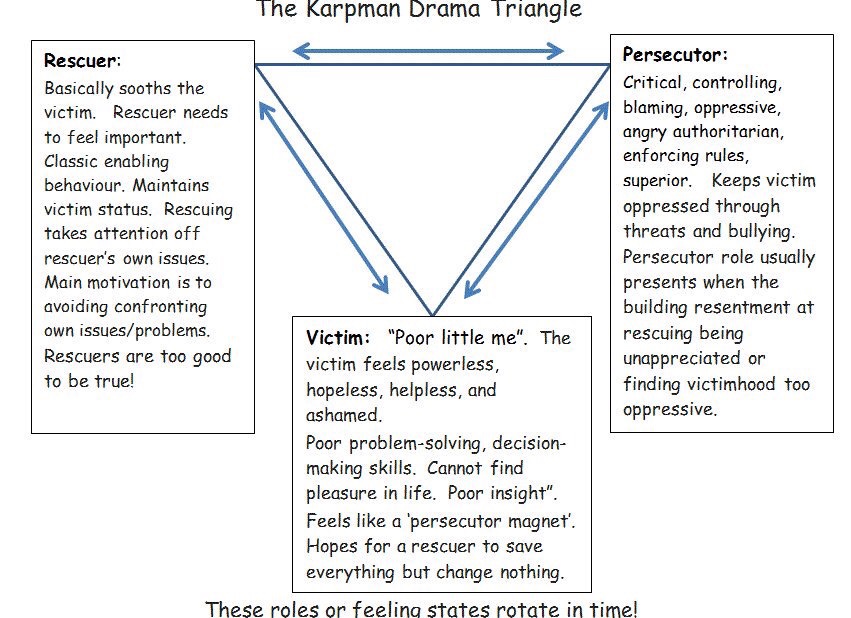
Karpman’s Drama Triangle is a simple tool to understand the dynamics of workplace bullying. The roles of the Persecutor, the Victim and the Enabler are not fixed. The bully is the persecutor in the first instance, however he or she sees himself as the victim. He or she is able to get leadership to look away by blaming the victim and portraying the victim as the abuser in situations where their victim is not present to defend himself or herself.
The victim lacks self-confidence, is filled with fear and feels isolated. The bully like any predator preys on that fear and is threatening and pleasant by turns like any abuser to keep the victim locked into the abusive relationship. The victim like a battered woman is unable to break free partly because there are observers of this dynamic known as enablers.
There are two types of enablers. The first category of enablers openly supports the bully and either choose not to see or are simply blind to the abuse. They are often the friends in high places, peers or favored employees and will support the bully, even joining in to attack the victim. They sometimes see themselves as rescuing the Persecutor from his or her perceived abuse by the victim.
The other category of enablers are the silent observers. They may listen to the victim, observe the abuse but they neither report it nor do they support the victim in any effective way. They are often filled with fear themselves, having been victims or are simply grateful not to be on the receiving end of the harassment and abuse. They do not take any action because they don’t want to rock the boat and get onto the abuser’s wrong side. The abuser knows this and exploits the dynamic to his advantage.
Profiles of the Bully and The Victim
Workplace bullies have distinct personality traits and victims have distinct profiles which make them susceptible to abuse. According to an article on http://www.hrmorning.com, bullies can be identified by 8 distinct personalities:
1. The Screaming Mimi. This is the most easily recognizable type of workplace bully. Screaming Mimis are loud and obnoxious, and their abusive behavior is meant to berate and humiliate people. They thrive on the notion that others fear them.
2. The Two-Headed Snake. To a co-worker’s face, this employee acts like a trusted friend or colleague. However, when the co-worker is out of earshot, this person will destroy his colleague’s reputation, stab him in the back and even take credit for his work.
2. The Constant Critic. This bully’s goal is to dismantle other people’s confidence through constant – and often unwarranted – criticism. A critic will look for any possible flaw in someone’s work and labors tirelessly to kill that person’s credibility. Impeccable work? No problem: This type of bully isn’t above falsifying documents or creating evidence to make others look bad.
4. The Gatekeeper. Every office has at least one employee who gets off on wielding his or her power over others – regardless of whether that power is real or perceived. Gatekeepers deny people the tools they need – whether it’s resources, time or information – to do their jobs efficiently.
5. The Attention Seeker. This type of bully wants to be the center of the action at all times. They’ll try to get on their superior’s good side through consistent flattery and even come on as kind and helpful to their peers – especially the newer employees. However, if co-workers don’t provide the right amount of attention, these bullies can quickly turn on them.Attention seekers are often overly dramatic and relate everything to something that’s going wrong in their own lives to garner sympathy and control. These bullies also have a tendency to coax personal info out of new employees – only to use it against them later.
6. The Wannabe. This is an employee who sees himself or herself as absolutely indispensable and expects recognition for everything. But Wannabes aren’t usually very good at their jobs. To compensate, these bullies spend a majority of their time watching more competent workers and looking for areas of skilled workers’ performance to complain about. Wannabes will demand that everything is done their way – even when there are better ways of doing things. Because they’re automatically opposed to others’ ideas, they’ll do everything in their power to prevent changes to their work processes.
7. The Guru. Generally, there’s nothing wrong with this bully’s work performance. In fact, it’s not unusual for a Guru to be considered an expert in his or her own niche area. What these bullies offer in technical skill, however, they severely lack in emotional maturity. Gurus see themselves as being superior to their co-workers. As a result, they don’t consider how their actions will affect others, aren’t able to fathom the possibility that they can be wrong and don’t accept responsibility for their own actions. In addition, because these bullies feel as though they’re “above it all,” they don’t always feel compelled to follow the same rules as everybody else.
8. The Sociopath. Intelligent, well-spoken, charming and charismatic, sociopaths are the most destructive bullies of all. Reason: They have absolutely no empathy for others, yet they are experts at manipulating the emotions of others in order to get what they want. These bullies often rise to positions of power within the company, which makes them extremely dangerous. Sociopaths tend to surround themselves with a circle of lackeys who are willing to do their dirty work in exchange for moving up the ranks with them.
An article on http://www.balancecareers.com states that victims of bullying are generally:
1. Intelligent, articulate, self-assured and competent. This makes the bully feel insecure because they feel that they do not measure up and will lose their position. This includes superiors who can be jealous of a subordinate.
2. Non-confrontational, submissive, passive, meek or quiet. The bully feels like they are vulnerable because of their financial circumstances and therefore unlikely to retaliate confront or report them.
3. New in the organisation and have not yet established relationships with co-workers. They might be on the fringes of or excluded from workplace cliques.
4. Inexperienced, older, or handicapped employees as well, including those struggling with depression or stress and anxiety disorders. Bullies are often vulnerable themselves, so bullying helps them conceal their own insecurities and create the appearance that they’re in control.
5. Caring, social, and collaborative co-workers for whom collaboration, compromise, team building, and consensus-seeking are second nature. While these character traits are important elements of a healthy work team, they ironically can exacerbate bullying.
6. Employees with a strong support network within the workplace, who share solid friendships and associations with others, are often targeted because the bully is excluded from these inner circles. He or she might act out of resentment and frustration.
7. Fair, honest, and ethical co-workers with integrity and strong moral values are targeted because the bully doesn’t possess these traits himself or his target’s values conflict with his own. Whistleblowers who expose fraudulent or unethical practices are often bully targets.
8. Female. A survey by the Workplace Bullying Institute in the US found that 70 percent of bullies were men and 65 percent of their targets were women. The survey also revealed that women bullies target women 67 percent of the time.
9. Of a different race. The article talks about minority race groups as targets, however, in South Africa, the experience is different because the majority of leadership in companies are White or Indian. Bullying is normally done by those who are in a superior social position. Anecdotal evidence from social media indicates that black and coloured employees and foreign nationals are more affected by bullying in the workplace.
10. People that look different or possess some physical trait that separates you from others. A victim of bullying might be very tall or very short, have a scar or weight problem. Their appearance opens the door for teasing, taunting, and ridicule.
Are You Being Bullied At Work? Here’s What You Can Do About It?
Being bullied is shocking and stressful. You feel isolated and the bully will often gaslight you, making you think it’s your fault and causing you to question your own sanity. They will gang up on you with other managers or employees and want nothing better than to make your life miserable. Once you begin to experience repeated abuse and harassment by a subordinate, colleague or superior, do the following things:
- Remember that the bully is the one with the problem, not you. Create emotional distance by being civil and polite but don’t try to ingratiate yourself with the bully. They already hate and fear you so you have nothing to lose.
- Verify everything they say. Bullies often lie to instil fear, maintain control and have their way. Ensure that you have the correct version of what higher level management are saying.
- Where possible, document anything agreed in writing. This includes meeting notes and follow up emails with agreed actions clearly identifying who is responsible for what action to prevent them from lying in future and blaming you.
- Document every incident no matter how trivial it seems. This shows a pattern.
- Read the company’s policy & follow the grievance procedure if it exists. If not, make your complaint in writing to the bully’s manager. Document the response, if the manager is friends with the bully, go to the next level of management and do the same until someone does something. Ensure that HR is informed in writing every step of the way. It’s tedious but you will need this documentation should you have to go to the CCMA or the Labour Court if you are unfairly dismissed.
- Use the Whistle-blower process to make your complaint anonymously if one exists, particularly in situations where management favours the bully.
- Confide in a colleague or someone you can trust, bullies always need a victim and there will be a history involving other employees. If you don’t have someone, speak to someone in a different team or outside the company.
- Prepare yourself for a fight because bullies will want to protect their reputation at your expense. They will find fault with your work & claim you’re a non-performer to their superiors, and spread damaging rumors about you including personal stuff.
- Take care of yourself physically and do things to help you manage stress. This will ensure you are ready for the fight.
- If the bully yells at you in front of everyone, stay calm, look him or her say his or her name and ask them to clarify what the problem is. This catches them off guard and slows the conversation down. Do it for as long as you need to. Suggest that the two of you discuss the issue separately. If you’re feeling emotional or scared, excuse yourself and leave the room. For more tips on dealing with bullies go to http://www.softpanorama.org where they discuss techniques on dealing with paranoid incompetent managers, narcissists and other toxic management practices.
- Look for another job secretly, whether you take up the issue or not. Generally relationships are so poor at this point, working with the bully is not a sustainable option. Management rarely have the courage to intervene in cases of bullying.
- When asked for your reasons for leaving, say you were looking for a more challenging opportunity or career growth in a different area. Kathy Caprino, in a great article on workplace bullying on forbes.com suggests saying that you work best with a leader who gives you the opportunity to assume roles of increasing responsibility and is transparent and collaborative in their communication.
- Get other people to give references on your CV. If the prospective employer asks you whether they can contact your previous boss, say no if you have the option. Given the opportunity, bullies will ruin any opportunities for people who want to leave their employ. When you resign, don’t tell everyone where you’re going until you are established, because they can be very vindictive and create problems for you at your new job.
What Can Company Leadership Do About Workplace Bullying?
Company leadership including managers and executives has a responsibility to prevent and deal with workplace bullying. The consequences of allowing it to persist include a bad reputation as an employer, decreased financial performance due to low morale and legal action and financial loss if the case ends up in front of the CCMA or in the Labour Court. The negative effects of bullying outweigh the temporary financial gains where the bully achieves results through fear and intimidation.
- Invite professionals to educate leaders about bullying in the workplace
- Develop policies regarding acceptable behaviour in the workplace and ensure that all employees have read and understand it
- Create channels of communication to enable employees to lay complaints about ill-treatment without victimization.
- Deal with incidents of bullying by following due process and the requirements of labour law.
- Do not give bullies a second chance. Accommodating them by transferring the employees who complained means prolonged misery for other employees. They must bear the full consequences of their actions.
Doing these things will send a strong message to the organisation that bullying will not be tolerated. A company needs dedicated loyal and innovative employees to navigate the changes in the industry and workplace and to remain relevant to their customers. Creating a safe environment at work will enable employees to be more creative and productive and the company can only benefit.
References
https://www.thebalancecareers.com/who-is-a-workplace-bully-s-target-2164323
https://powerofted.com/the-drama-triangle/
 The Corporate Humanitarian